
How to Choose the Right Table Edge for Your Home
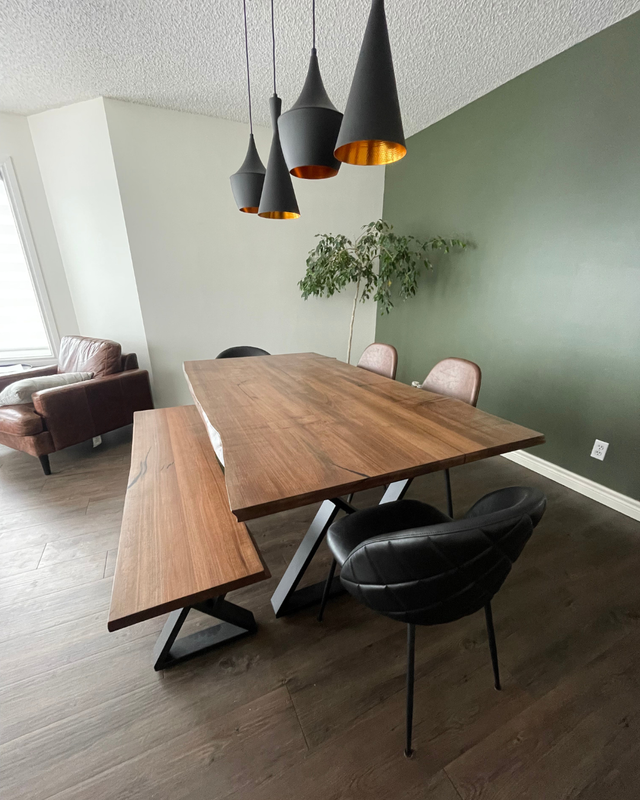
How to Choose the Right Table Edge for Your Home
Live edge or clean edge changes how large the table feels, how easily people move around it, and how well it works with everything already in the room. Here's a practical checklist before you decide.
Choosing a custom dining table isn't only about finding beautiful wood. The edge changes how large the table feels, how easily people move around it, and how well it works with everything already in the room.
Before choosing live edge or clean edge, use this practical checklist.
Look at what's already competing for attention
Walk into your dining area and notice the strongest details. Do you have patterned flooring, statement lighting, bold chairs, visible beams, or an open staircase? If the room already has several focal points, a clean edge can give the space more balance.
If the room feels simple or needs warmth, live edge can introduce natural movement and character.
Measure the room, not your current table
A table can look perfectly sized in a showroom and feel crowded once it arrives home. Measure the full dining area, then account for:
- The table dimensions
- Chair depth
- Space needed to pull chairs out
- Main walking paths
- Nearby doors, islands, or cabinets
- Benches that need room to slide out
Live-edge slabs naturally vary in width, so the narrowest and widest points both need to work in your room.
Think about how you actually use the table
A dramatic edge may look beautiful, but daily life should guide the decision. Ask yourself:
- Is this table mainly for family meals?
- Do children use it every day?
- Do you regularly host large groups?
- Will it double as a workspace?
- Does anyone prefer sitting at the ends?
- Do you need every seat to have consistent space?
A clean edge usually offers a more predictable seating layout. Live edge works beautifully when the slab's natural shape won't interfere with comfort or usable surface area.
Decide what you want people to notice first
Every custom table has a visual hierarchy. If you want the slab's natural shape to be the first thing people notice, live edge may be the right direction.
If the wood has exceptional grain, or you want the base, chairs, or architecture to stand out too, a clean edge can give those details more room to speak. The goal isn't to fit every interesting feature into one table, it's to decide which details deserve attention.
The goal isn't to fit every interesting feature into one table. It's to decide which details deserve attention.
Bring your room into the decision
Don't choose your table from memory. Bring clear photos and measurements when visiting the warehouse. Helpful items include:
- Wide photos of the entire dining area
- Flooring and cabinet photos
- Chair dimensions
- Room measurements
- Photos of nearby furniture
- Inspiration images showing what you like
- A rough estimate of how many people you seat regularly
These details help us recommend an edge, wood species, size, finish, and base that work together.
Compare the wood in person
Live edge can vary significantly from one slab to another. Some edges are soft and subtle. Others are highly irregular and become the strongest feature in the room. Seeing the wood in person lets you compare:
- Natural edge movement
- Grain pattern
- Colour variation
- Knots and character
- Overall width
- How the slab may be positioned and shaped
A photo can inspire the direction. The actual wood determines the final table.
Your Quick Decision Guide
If you want natural movement, visible character, and a table that acts as a focal point.
If you want consistent dimensions, structured lines, and a table that integrates quietly into the room.
Still unsure? Bring your room photos and measurements to the YEG Woodcraft warehouse. We'll help you compare the wood and choose a table that fits your space, not just the trend.
Deciding between live edge and clean edge?
Bring your room photos and measurements, we'll help you compare the wood in person.